Introduction to California's History and Historical Events
California is a state located on
the west coast of the United States. Here's a brief overview of the history of
California:
Native American Settlement:
California has a rich history of Indigenous peoples who inhabited the region for
thousands of years before European exploration. Various Native American tribes,
including the Ohlone, Miwok, Pomo, and Chumash, among others, lived in different
parts of the state, each with their own distinct cultures and languages.
Spanish Colonization:
The first European exploration of California took place in the 16th century when
Spanish explorers, including Juan Rodriguez Cabrillo and Sebastián Vizcaíno,
charted the coastline. However, Spanish colonization and settlement did not
occur until the late 18th century.
In 1769, Spanish missionaries, led by Father Junípero Serra, established the
first of 21 missions along the California coast. These missions aimed to convert
Native Americans to Christianity and establish Spanish presence in the region.
The mission system played a significant role in the economic, cultural, and
social development of California.
Mexican Rule and American Conquest:
Mexico gained independence from Spain in 1821, and California became part of the
Mexican territory. Mexican rule continued until the Mexican-American War in
1846-1848 when the United States acquired California as part of the Treaty of
Guadalupe Hidalgo.
Gold Rush and Statehood:
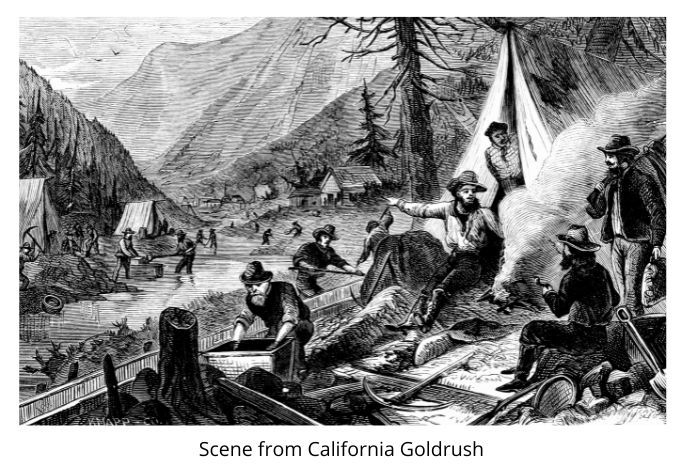
The discovery of gold at Sutter's Mill in 1848 triggered the California Gold
Rush, attracting hundreds of thousands of people from around the world seeking
their fortunes. The population exploded, transforming California into a diverse
and dynamic society.
 California was admitted to the Union as the 31st state on September 9, 1850,
becoming the first state on the West Coast. The rapid growth and economic
prosperity continued in the following decades, fueled by industries such as
agriculture, mining, and trade.
Railroads, Agriculture, and Industrialization:
The completion of the First Transcontinental Railroad in 1869, connecting
California to the eastern states, further accelerated the state's growth. The
railroad facilitated transportation and trade, boosting California's economy and
population.
Agriculture became a vital industry, with the fertile Central Valley providing
an ideal environment for crops such as citrus fruits, grapes, and vegetables.
Industrialization also took hold, with the rise of oil production,
manufacturing, and the development of cities like Los Angeles and San Francisco.
20th Century and Beyond:
In the 20th century, California experienced significant social, cultural, and
economic changes. It played a prominent role in World War II, serving as a major
center for military production and hosting important military bases.
The post-war period witnessed a boom in population, driven by suburbanization,
the aerospace industry, and the entertainment industry centered in Hollywood.
California became synonymous with the American Dream and attracted people from
across the United States and around the world.
Today, California is the most populous state in the United States and continues
to be an economic powerhouse, with diverse industries including technology,
entertainment, agriculture, and tourism. It is known for its cultural diversity,
technological innovation, iconic landmarks (such as the Golden Gate Bridge and
Hollywood sign), and natural beauty, including its coastline, national parks,
and mountain ranges.
This overview provides a general understanding of the history of California, but
there are many more details and significant events that have shaped the state
over time.
Area
163,707 square miles.
Furthest North to Furthest South
770 miles.
Furthest East to Furthest West
370 miles.
Population Density
182 per square mile.
Licence Plate
Background: White.
Image: The sun on the horizon.
Text: "California - The Golden State".
State Road Sign
A rounded green triangle with a white border. This is a stylised representation
of a miner's shovel (from the California Gold Rush of 1849).
Derivation of Name
California was named by Hernan Cortes after an imaginary island in a popular
Spanish novel of the time.
Nickname
The Golden State.
Climate
Eureka: January high 54F, July high 60F.
Fresno: January high 55F, July high 98F.
Los Angeles: January high 67F, July high 83F.
Needles: January high 63F, July high 108F.
San Francisco: January high 56F, July high 64F.
Yosemite: January high 45F, July high 90F.
California
Home | States/Provinces
| Subjects
